How to Reconstruct Missing Business Transactions When You Have No Records

Missing business transactions create a specific kind of fear. You open your accounting software and see gaps where income and expenses should be. The records you need to rebuild those gaps no longer exist. The solution is not to panic or guess. A structured reconstruction process rebuilds your financial history from secondary sources and restores accuracy without fabricating a single number.
Most business owners assume that lost records mean lost deductions. They believe the IRS requires a perfect receipt for every transaction or the entire deduction disappears. This assumption is partially false. The IRS requires substantiation, and substantiation can come from multiple sources beyond a single paper receipt.
Fiscal integrity means rebuilding your books with verifiable evidence, not invented numbers. This guide walks through the exact reconstruction framework we use to recover missing transactions when the original records are gone. Every step relies on documents that already exist in your financial ecosystem.

Why Transactions Go Missing in the First Place
Transactions do not vanish because of a single catastrophic event. They disappear through a series of small oversights that compound over time. Understanding how the gap happened prevents you from rebuilding the same broken system after the cleanup.
The most common cause is a bank feed disconnection. Accounting software loses its connection to your bank or credit card, and transactions stop flowing in automatically. If nobody notices, months pass with a growing gap in the ledger. The software shows a balance that no longer matches reality.
Other causes include a lost physical wallet of receipts, a crashed hard drive that held digital records, a bookkeeper who quit without handing off the files, or a business owner who simply stopped entering transactions during a busy season. Every cause has the same result. The books no longer reflect what actually happened.
The Difference Between Missing and Lost
Missing transactions are transactions that occurred but were never recorded in your accounting software. Lost records are the source documents that prove those transactions happened. You can have missing transactions with intact records, and you can have recorded transactions with lost records. The reconstruction process handles both, but the approach differs.
When transactions are missing but records exist, you simply reenter the data from the source documents. When records are lost, you must rebuild the transaction history from secondary evidence. This guide focuses on the harder problem. Reconstructing transactions when the primary records no longer exist.

Step One: Pull Every Available Secondary Source
Before you attempt to reconstruct anything, gather every piece of secondary evidence that still exists. Secondary sources are documents that were not created for bookkeeping purposes but still contain transaction data. They are the foundation of your reconstruction.
Start with your bank and credit card statements. Most financial institutions retain statements for at least seven years online. Download the official PDF exports for every month in the gap period. These statements show every transaction that moved through your accounts, including the date, amount, and merchant name.
Do not rely on screenshots or memory. Official PDF statements carry weight with the IRS because they are generated by the financial institution itself. They are the single most reliable secondary source for transaction reconstruction.
Expand Beyond Bank Statements
Bank statements only capture transactions that moved through a connected account. Cash transactions, payments made through third party apps, and transfers between accounts require additional sources. Pull the following records for the entire gap period.
- Payment processor reports from Stripe, PayPal, and Square.
- Merchant account settlement reports.
- Loan and credit line statements.
- Vendor invoices and purchase orders.
- Customer invoices and payment confirmations.
- Email receipts and digital purchase confirmations.
- Mileage logs and calendar entries for travel.
- Payroll reports from your payroll provider.
Every source adds a piece of the puzzle. A vendor invoice confirms a purchase even if the receipt is gone. A customer email confirms a sale even if the invoice was never recorded. The goal is to assemble enough evidence to reconstruct each transaction with confidence.
Step Two: Build a Transaction Master List
Once you have gathered every available source, build a single master list of transactions. Use a spreadsheet with columns for date, amount, merchant or payee, source document, and category. This master list becomes the blueprint for your reconstruction.
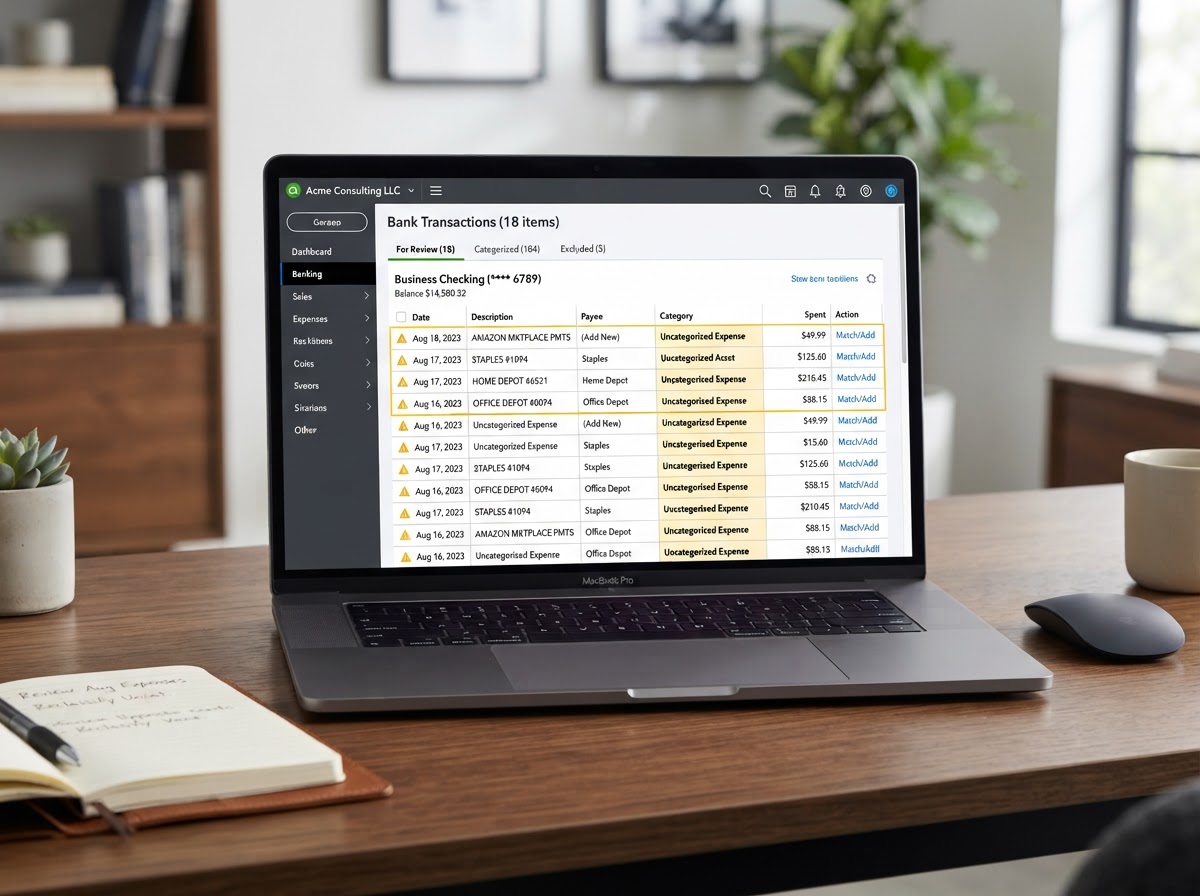
Enter every transaction from every source into the master list. When the same transaction appears in multiple sources, enter it once and note the confirming sources in the source column. Multiple sources confirming a single transaction strengthens the substantiation significantly.
Sort the master list chronologically. This order matters because it matches how transactions actually occurred and how your accounting software expects them to be entered. Chronological entry makes reconciliation dramatically easier later in the process.
Handle Cash Transactions Carefully
Cash transactions are the hardest to reconstruct because they leave no bank trail. If you have no record of a cash purchase, you cannot reconstruct it with confidence. Do not invent cash transactions to balance your books. Invented numbers destroy fiscal integrity and create audit risk.
Instead, look for indirect evidence of cash spending. ATM withdrawal records show when cash left your account. Calendar entries and appointment logs may indicate what the cash was used for. Vendor relationships may confirm that you paid in cash. Use this indirect evidence to estimate cash transactions, and flag every estimate clearly so your accountant can review it.
Step Three: Reconstruct Income First
Income is generally easier to reconstruct than expenses because customers create records of their payments. Every deposit in your bank account represents income, and the source of each deposit can usually be traced.
Match each deposit to a customer or revenue source. If you use a payment processor, the settlement reports show which customer payments comprised each deposit. If you deposited checks manually, the bank statement images show the check writer and amount.
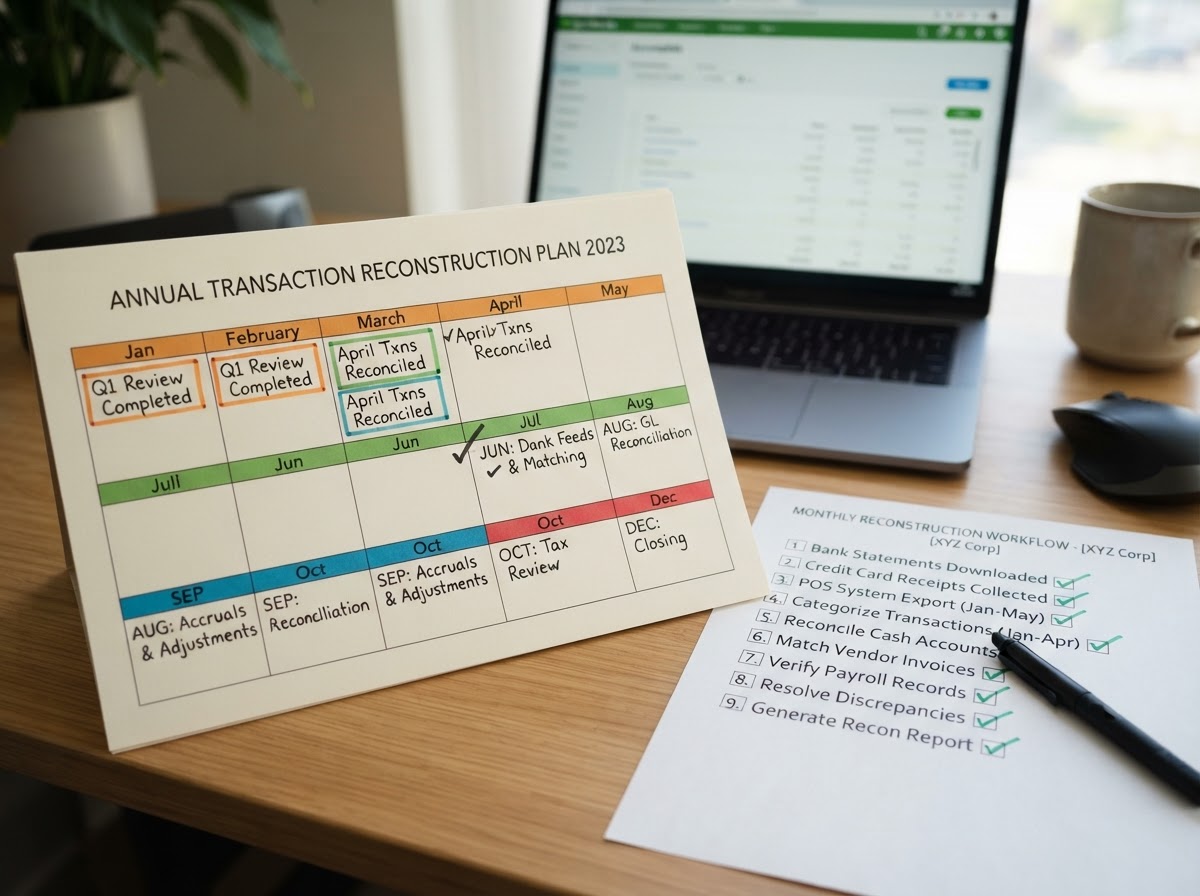
Reconstruct income before expenses because it establishes the top line of your profit and loss statement. Once you know your true revenue, you can assess whether your reconstructed expenses make sense in proportion. A business with $200,000 in reconstructed revenue and $40,000 in reconstructed expenses has a credibility problem that requires further investigation.
Step Four: Reconstruct Expenses by Category
With income established, move to expenses. Work category by category rather than month by month. This approach reveals patterns and gaps more clearly than a chronological sweep. Start with the largest expense categories and work downward.
For each category, pull every source that could contain relevant transactions. Reconstruct payroll from payroll provider reports. Reconstruct rent from lease agreements and bank statements. Reconstruct materials from vendor invoices and purchase orders. Reconstruct subcontractor costs from 1099 records and bank payments.
Assign each reconstructed transaction to the correct expense account in your chart of accounts. If you are unsure about a category, flag it for review rather than guessing. A flagged transaction gets reviewed. A guessed transaction creates a silent error that compounds over time.
Use the Cohan Rule for Partial Records
The IRS recognizes a legal principle called the Cohan rule. It allows taxpayers to deduct expenses even when exact records are missing, as long as the expense is proven to have occurred and the amount can be reasonably estimated. This rule does not give you permission to invent numbers. It provides a framework for estimating a real expense when exact documentation is unavailable.
To use the Cohan rule, you must demonstrate that the expense category existed and that you incurred costs in it. Bank records showing payments to vendors, calendar entries showing business activity, and industry averages can all support a reasonable estimate. Document your estimation method clearly so your accountant and the IRS can follow your logic.

Step Five: Reconcile Against Known Balances
Reconciliation is the proof that your reconstruction is accurate. You cannot simply enter reconstructed transactions and trust the result. You must confirm that the reconstructed balances match known reference points.
Start with your bank statement ending balance for each month in the gap period. Your reconstructed transactions, when entered into the accounting software, must produce a balance that matches the bank statement. If the numbers do not match, a transaction is missing or incorrect.
Investigate every discrepancy until the reconciliation balances to zero. Never force a reconciliation by entering a plug number. A plug hides the real problem and guarantees it will resurface during tax preparation or an audit. Fiscal integrity demands that every number traces to a verifiable source.
Common Reconstruction Discrepancies
- Bank fees not captured in the reconstruction.
- Interest income or expense omitted from the master list.
- Transfers recorded as income or expense.
- Duplicate entries from overlapping source documents.
- Cash withdrawals recorded as expenses without categorization.
Each discrepancy reveals a gap in your source gathering. When you find one, return to step one and search for additional records that cover the discrepancy. The reconstruction is complete only when every account reconciles perfectly.
Step Six: Generate and Review Financial Statements
Once all reconstructed transactions are entered and reconciled, generate a profit and loss statement and a balance sheet for the gap period. These reports reveal whether your reconstruction tells a coherent financial story.
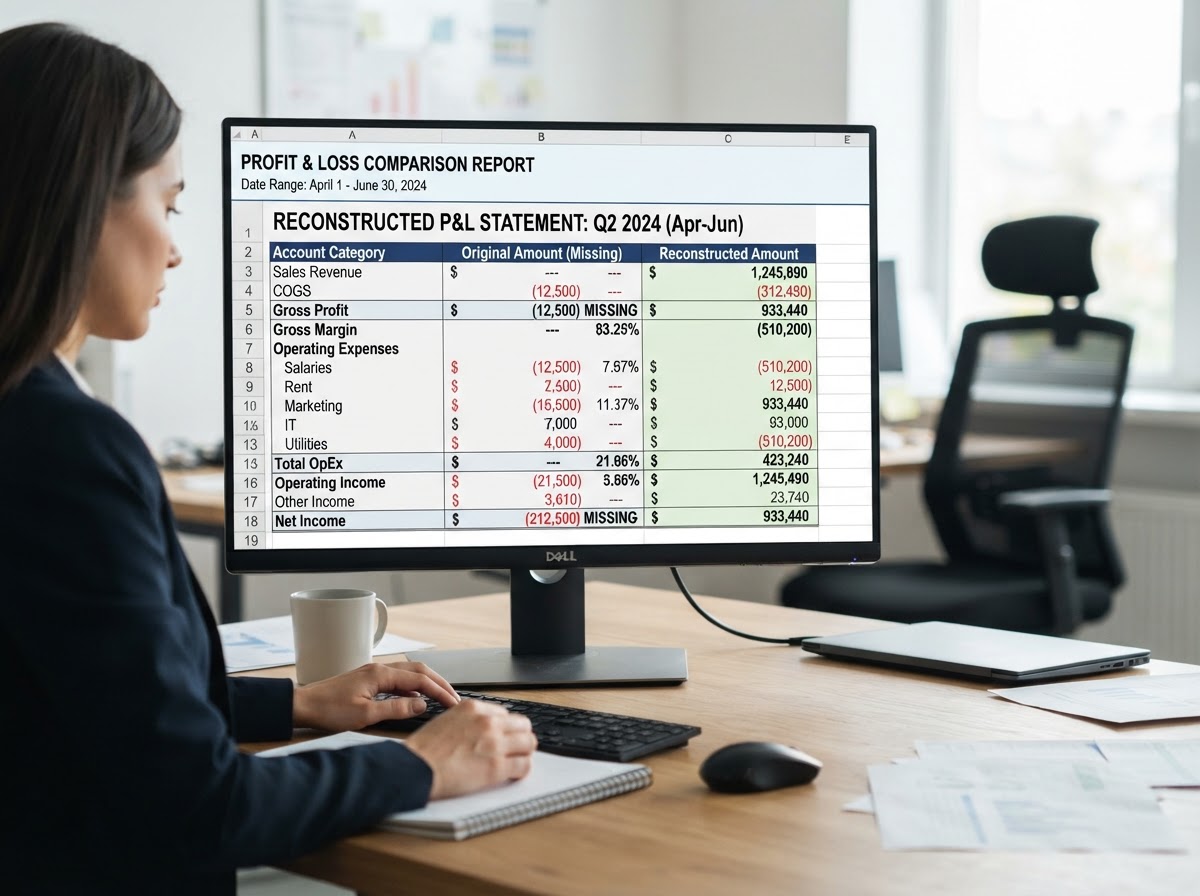
Review the profit and loss statement for reasonableness. Compare your reconstructed margins against industry benchmarks. If your net profit margin is dramatically higher or lower than industry averages, your reconstruction may be missing a category of expenses or income.
Review the balance sheet for impossible numbers. Negative cash balances indicate missing deposits. Negative accounts receivable indicate payments recorded without matching invoices. Negative equity often signals that personal funds contributed to the business were never recorded.
Every impossible number on the balance sheet points to a specific gap in your reconstruction. Track each one back to its source and resolve it. The balance sheet must balance. If it does not, the reconstruction is incomplete.
Step Seven: Document Your Reconstruction Method
The reconstruction itself is only half the work. The other half is documentation. If the IRS ever questions your reconstructed numbers, you must be able to explain exactly how you arrived at each figure.
Create a reconstruction memo that describes the gap period, the sources you used, the estimation methods you applied, and the reconciliation results. Attach the master list and the source documents. Store this package with your tax records for the relevant years.
Good documentation transforms a reconstruction from a liability into an asset. A well documented reconstruction demonstrates fiscal integrity. It shows that you took the gap seriously, rebuilt your books with verifiable evidence, and maintained professional standards throughout the process.
The Zion Approach and Strategy
At Zion Accounting and Tax, we treat transaction reconstruction as a forensic exercise. We do not guess. We do not plug numbers. We rebuild your financial history from every available source until the books reconcile perfectly and the story makes sense.
Our team starts by mapping the full scope of the gap. We identify every month affected, every account involved, and every source document that still exists. We then build a master transaction list from bank statements, payment processor reports, vendor invoices, customer records, and any other evidence we can locate.
We reconstruct income first to establish the top line, then work through expenses category by category. We apply the Cohan rule only where indirect evidence supports a reasonable estimate, and we document every estimation method in a formal reconstruction memo. When we finish, your books balance, your financial statements tell a coherent story, and your tax filings rest on verifiable evidence.
We Build Systems That Prevent the Next Gap
Reconstruction is expensive and stressful. Prevention is neither. Once we rebuild your books, we implement systems that ensure you never face this problem again. We connect automated bank feeds, schedule monthly reconciliation deadlines, and establish a communication cadence that keeps your books current without requiring your daily attention.
We review your books weekly instead of monthly to spot gaps before they grow. This proactive approach catches missing transactions within days instead of months, when the records still exist and the fix is simple. When our clients grow, we grow too, and growth requires clean, current, reliable financial data.

Stop Letting Missing Records Control Your Business
You can reconstruct missing transactions alone. The steps in this guide are proven and repeatable. Gather every secondary source, build a master list, reconstruct income and expenses, reconcile against known balances, and document your method. The process works.
But an unshakeable financial foundation requires more than a one time reconstruction. It requires a dedicated partner who keeps your books current, catches gaps before they grow, and provides the strategic guidance you need to grow with confidence. When your financial foundation is solid, your business can truly thrive. We believe that fiscal integrity is the anchor that holds everything together.
Stop letting missing records control your business. Stop hoping the gap will somehow resolve itself. Take control of your financial future today.
Ready to rebuild your books?
We specialize in transaction reconstruction without judgment. Let us pull you out and set up a system that keeps you current.
Related Insights
View all insights
I Forgot to Record Transactions for Three Months: How to Fix This
Three months of unrecorded transactions is the most common bookkeeping gap we encounter. A structured, month by month recovery plan restores accuracy in days, not weeks.

Two Years Behind on Bookkeeping and Tax Season Is Coming
Two years of untouched books feels like a death sentence for your finances. The reality is far more manageable than the panic suggests with a structured year by year reconstruction plan.

My Books Are a Complete Mess: Where to Even Start Cleaning Up
Many business owners open their accounting software, see hundreds of uncategorized transactions, and immediately close it. The mess feels so enormous that paralysis sets in.