I Have Multiple Income Streams and No Idea How to Track Any of It

You launched a service business, then added a consulting arm, then started selling digital products, then picked up a few freelance contracts on the side. Each income stream deposits into a different account through a different platform on a different schedule. Your bookkeeping has become a tangled web of disconnected deposits that nobody can explain. The solution is not a bigger spreadsheet. It is a unified tracking system that maps every dollar to its source so you can see which streams actually generate profit.
Why Multiple Income Streams Break Standard Bookkeeping
Standard bookkeeping assumes a single business with a single checking account and a single revenue source. The moment you add a second stream, that simple model collapses. A deposit from your consulting client looks identical to a payout from your online store. Without a system to tell them apart, every revenue line becomes a guess.
The problem compounds with every new platform you adopt. Stripe sends a payout that bundles three days of sales minus fees. PayPal deposits a client payment that includes a tip. Venmo drops in a personal transfer that has nothing to do with your business. When all of these land in the same account, your bookkeeping software guesses at the categories and guesses wrong more often than not.

The First Step Is a Complete Income Inventory
Before you touch a single transaction, you need to know exactly how many income streams you have and where each one deposits. Open a blank document and list every source of money that flows into your business. Do not skip the small ones. A $200 affiliate payment is still an income stream that needs tracking.
Next to each source, write the platform, the deposit account, and the deposit frequency. This inventory becomes the blueprint for your entire tracking system. You cannot organize what you have not fully identified. Most business owners are shocked to discover they have eight or nine distinct streams when they assumed they had three.
What Your Income Inventory Must Capture
- The legal name of each income source or client type
- The platform that processes each payment
- The bank account where each deposit lands
- The typical deposit frequency and schedule
- The average monthly volume from each stream
This inventory takes an afternoon to complete and it is the foundation for everything that follows. Every categorization rule, every reconciliation workflow, and every profitability report you build later traces back to this list.

Build a Chart of Accounts That Reflects Reality
Your chart of accounts is the backbone of your bookkeeping system. It is the list of categories where every transaction lands. For multiple income streams, you need a revenue account for each distinct source. A single generic revenue account hides the information you need most.
Create a separate income account for each stream. Name them clearly so anyone reading your books understands them instantly. Consulting Revenue, Product Sales, Affiliate Income, and Freelance Contract Income are far more useful than a single line called Revenue. When your profit and loss statement breaks revenue out by source, you can finally see which streams are growing and which are draining your time.
The Revenue Account Standard
- One income account per distinct revenue stream
- Clear, descriptive names that anyone can understand
- No generic catchall accounts that hide detail
- Consistent naming across all platforms and reports
- Review the chart of accounts quarterly as streams evolve
Use Class Tracking to Separate Streams Within a Single Account
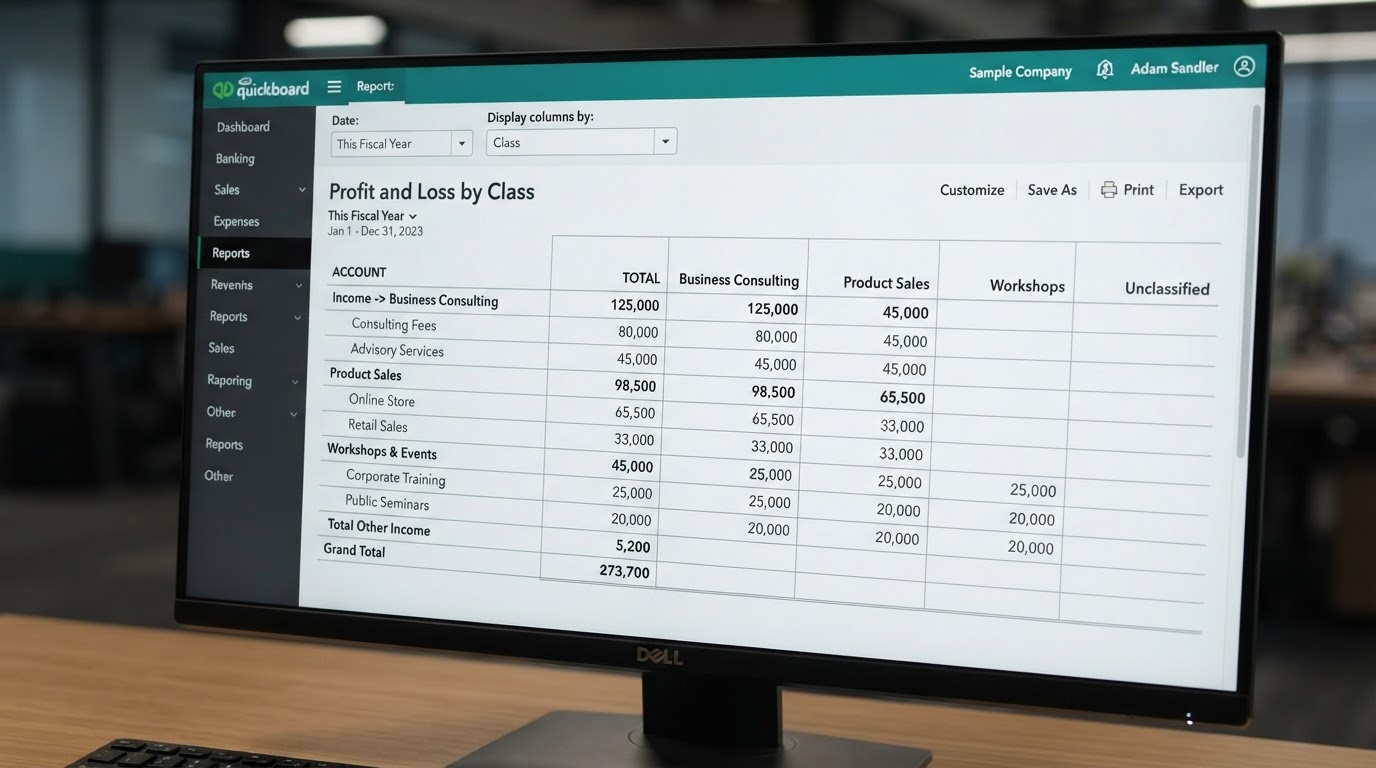
QuickBooks Online and other modern accounting platforms offer a feature called class tracking or location tracking. This feature lets you tag every transaction with a label that identifies which stream it belongs to. You can run a profit and loss statement filtered by class and see the exact profitability of each stream independently.
Class tracking is the single most powerful tool for a business with multiple income streams. It lets you share overhead costs across streams proportionally. It shows you which stream carries its own weight and which one is subsidized by the others. Without class tracking, you are flying blind on profitability.
How to Set Up Class Tracking Properly
- Enable class tracking in your accounting software settings
- Create one class for each income stream you identified
- Tag every transaction with the correct class as it enters
- Allocate shared expenses like rent and software proportionally
- Run a profit and loss by class report every single month
When class tracking is set up correctly, a single report answers the question every business owner with multiple streams actually cares about. Which stream makes me the most money for the least effort. That answer changes how you spend your time and where you invest your energy.
Reconcile Every Platform and Every Account Separately
Reconciliation is the proof that your numbers are correct. With multiple income streams, reconciliation becomes more complex because you have more accounts and more platforms to verify. Each one must be reconciled independently against its own source document.
Download the statement from each platform and match it against the deposits in your accounting software. Stripe payouts must match your Stripe revenue. PayPal transfers must match your PayPal sales. When a platform bundles fees into the payout, separate the fees from the revenue so your gross income is accurate. Skipping this step means your revenue is understated and your expenses are understated, and your profit looks different than it actually is.

The Platform Reconciliation Checklist
- Match each platform payout to the underlying sales transactions
- Separate processing fees from gross revenue on every payout
- Confirm the deposit amount matches the platform export
- Flag any payout that does not match for immediate research
- Reconcile each platform on its own schedule, not all at once
Separate Personal Transfers From Business Income
When you have multiple income streams, the line between personal and business money blurs quickly. A Venmo payment from a friend looks identical to a client payment. A personal transfer between your own accounts looks like business revenue. These commingled transactions corrupt your revenue numbers and inflate your taxable income if left uncorrected.
Create a strict rule for every personal transfer. Code it to an owner contribution or owner draw account, never to a revenue account. When a deposit is unclear, do not guess. Flag it and confirm the source before you categorize it. A single personal transfer miscoded as revenue can trigger an IRS question that costs you hours to explain.

Personal Transfer Rules That Protect Your Books
- Code every personal transfer to owner equity, never revenue
- Flag unclear deposits and confirm the source before categorizing
- Keep a separate business account for every business stream
- Never mix personal payment apps with business client payments
- Document the purpose of every transfer in the memo field
These rules feel rigid until the moment you need to explain a deposit to the IRS or a lender. Clean separation between personal and business money is the single most important habit a business owner with multiple streams can build.
Generate a Profit and Loss Statement by Stream Every Month
The entire point of tracking multiple income streams separately is to see which ones are profitable. A single combined profit and loss statement hides that answer. You need a profit and loss report broken out by class or by revenue account every single month.
Review the report and ask three questions about each stream. Is the revenue growing or shrinking month over month. Are the direct expenses proportionate to the revenue. Is the net profit margin healthy enough to justify the time you invest. The answers tell you exactly where to focus your growth energy and where to cut your losses.

What the Monthly Stream Report Reveals
- Which stream generates the highest net profit margin
- Which stream consumes the most overhead relative to revenue
- Which stream is growing fastest and deserves more investment
- Which stream is shrinking and may need to be sunset
- Whether your total business profit is concentrated or diversified
This report is the strategic compass for your entire business. Without it, you are guessing at where your profit comes from. With it, you make decisions based on evidence instead of intuition. The business owners who scale successfully are the ones who know their numbers down to the stream.
Consolidate Platforms Where Possible
Every platform you add increases your bookkeeping complexity. If you accept payments through Stripe, PayPal, Venmo, Square, and a bank transfer, you have five reconciliation workflows to manage every month. Each one is a chance for an error and a chance for a missed deposit.
Consolidate wherever you can. Route as many streams as possible through a single payment processor. Use one business checking account as the landing spot for every business deposit. The fewer platforms and accounts you maintain, the simpler your reconciliation becomes and the fewer errors you will introduce. Simplicity is a competitive advantage in bookkeeping.
The Zion Approach and Strategy
At Zion Accounting and Tax, we specialize in untangling the chaos of multiple income streams. When a client comes to us with eight disconnected revenue sources and no idea which ones are profitable, we do not hand them a generic template. We run a complete income inventory, build a chart of accounts that reflects their exact business, and set up class tracking so every stream is visible on its own.
We reconcile every platform and every account independently, separate processing fees from gross revenue, and flag every commingled personal transfer for immediate correction. We generate a profit and loss statement by stream every month and walk the client through what the numbers mean. The client never has to guess which stream is carrying the business because we show them the proof in black and white.
Our strategy is proactive, not reactive. Once the system is built, we maintain it monthly so the client always has current, accurate numbers to make decisions from. We run quarterly tax planning sessions that use the stream level data to identify legal tax savings before the year ends. When our clients grow, we grow too, and our clients grow fastest when they know exactly which streams to pour fuel on and which to wind down. We do not just record your financial history. We actively guide your financial future.

You Can Track Multiple Streams Alone, But You Do Not Have To
Every step in this guide is something you can attempt on your own. You can build the inventory, set up the chart of accounts, enable class tracking, and reconcile every platform yourself. Plenty of business owners try. Most of them fall behind because the volume of reconciliation work across multiple platforms is far greater than they estimated, and the monthly stream report never gets generated because the categorization is never quite finished.
An unshakeable financial foundation requires more than good intentions. It requires a dedicated partner who knows your business, who reviews your numbers proactively, and who turns a tangle of income streams into a clear profitability map. The businesses that scale successfully across multiple streams are the ones that stopped treating bookkeeping as a solo chore and started treating it as a strategic advantage. When your foundation is solid, your potential is limitless.
Trusted by small businesses and entrepreneurs who refuse to let a tangle of income streams hide their true profitability.
Related Insights
View all insights
It's the End of the Year and My Books Are Completely Behind: Help
December arrives and your books are still sitting where you left them in March. The solution is a structured, month by month recovery plan.

When Do Spreadsheets Stop Working for Small Business Bookkeeping?
Spreadsheets feel like a smart, low cost way to track your business finances in the beginning. That control is an illusion that shatters past a specific threshold.

How to Separate Personal and Business Expenses After Years of Mixing Them
You started your business with a single debit card and the best of intentions. Years later, your books are a tangled web of commingled funds.