You started freelancing to build freedom and flexibility. Instead you built a second job you never wanted: chasing down invoices from six different platforms, guessing which payments hit which account, and dreading the moment a client asks for a tax form. The solution is a unified bookkeeping system that maps every dollar to its source so you can see which clients actually generate profit and which ones quietly drain your time.

The Real Problem Is Not the Income, It Is the Fragmentation
Freelance income does not arrive in one clean stream. It arrives in fragments. One client pays you through a payment processor. Another wires money directly. A third uses a freelance marketplace that holds your earnings for weeks before releasing them. Each platform has its own fee structure, its own reporting format, and its own tax document schedule.
When you add it all up at the end of the month, the numbers rarely match what you remember earning. Fees eat into your gross revenue. Refunds reverse previous deposits. Marketplace holds delay payments you already counted as received. The result is a financial picture that looks accurate on the surface but hides the truth about your real profitability.
Fragmentation is the core problem. You are not disorganized because you are lazy. You are disorganized because the system you are trying to use, a single checking account and a spreadsheet, was never built to handle income from eight different sources arriving on eight different schedules.
Step One: Separate Your Business Money From Your Personal Money
The first and most important step is opening a dedicated business checking account. Every dollar of freelance income should land in that account first. Every business expense should leave from that account. Your personal money stays in your personal account.
This single change eliminates the majority of bookkeeping confusion freelancers face. When business and personal money mix in one account, you spend hours every month trying to remember which transaction was a client payment and which was a grocery run. A dedicated account removes that guessing game entirely.

Choose the Right Account Structure
If you operate as a sole proprietor, a separate personal checking account used exclusively for business is a reasonable starting point. If you have formed an LLC, a true business checking account is required. Commingling LLC funds with personal funds can pierce the legal protection that entity was built to provide.
Look for an account with no minimum balance, no monthly maintenance fees, and the ability to connect directly to accounting software. The connection feature matters more than the interest rate. You want your transactions to flow automatically into your bookkeeping system without manual entry.
Step Two: Map Every Income Source to a Category
Once your money flows through one clean account, the next step is categorizing where it came from. This is where most freelancers give up and dump everything into a single line called "Freelance Income." That approach hides the information you need most.
You need to know which clients and which platforms generate the most revenue. That data tells you where to focus your marketing, which clients to raise rates on, and which platforms to abandon because their fees eat your margin.
Build a Client and Platform Tracking System
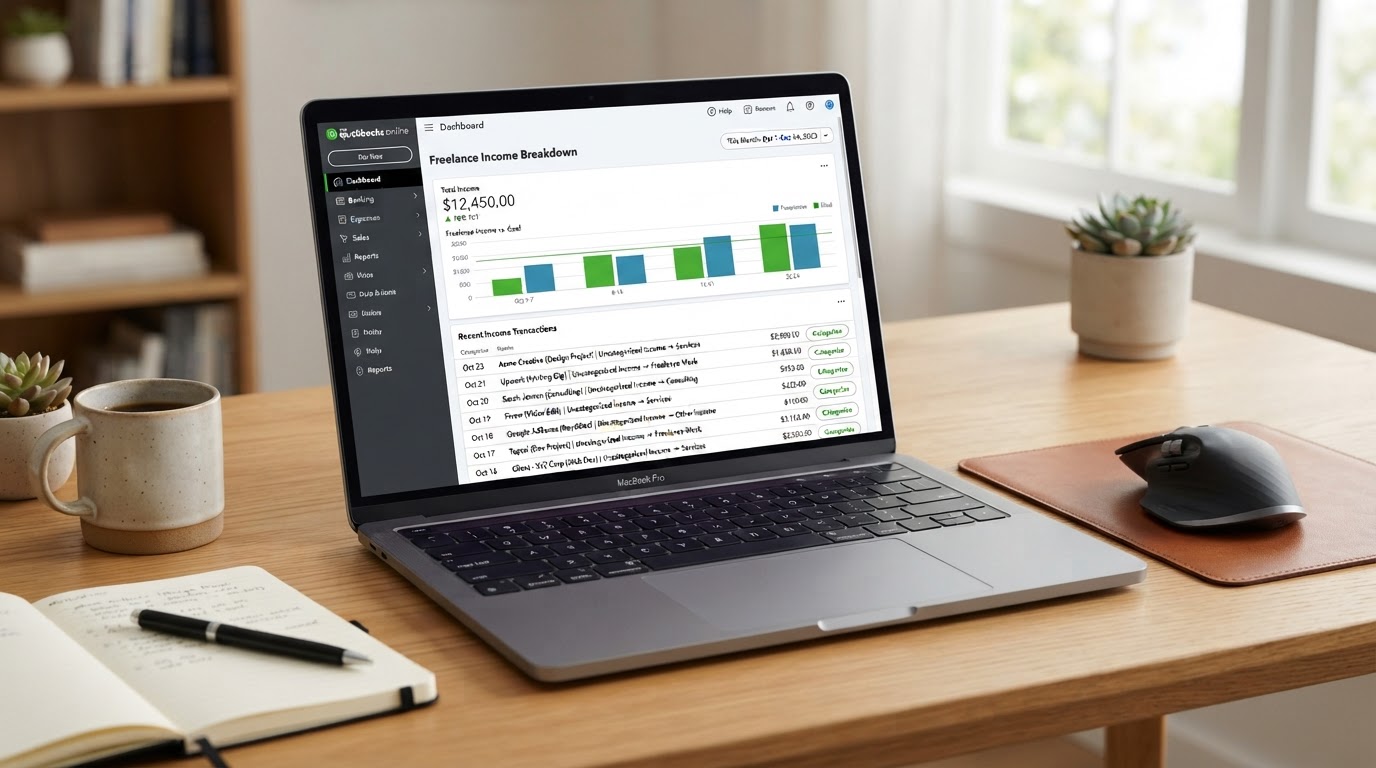
In your accounting software, create a separate income category or tag for each major client and each platform. When a payment arrives, you assign it to the correct source immediately. Over time, this builds a revenue breakdown that reveals which relationships actually pay off.
For example, you might discover that Client A pays well but always pays 45 days late. Client B pays a lower rate but never misses a deadline. Platform C takes a 20 percent cut that you forgot to account for. This kind of visibility is impossible when every deposit lands in the same bucket.
Step Three: Track Every Platform Fee as a Real Expense
Freelance platforms do not send you the full amount you earned. They deduct their fees before the money ever reaches your account. Most freelancers record the net deposit as their income and never track the fee separately. This creates a false picture of both revenue and expenses.
The correct approach is to record the gross amount as income and the platform fee as a separate expense. This shows your true earning power and gives you a deductible expense that reduces your taxable income. It also forces you to see exactly how much each platform is costing you every month.

Understand the 1099 Reporting Threshold
Payment platforms issue Form 1099-K when your earnings cross a reporting threshold. The threshold has shifted in recent years, so you must verify the current requirement for your situation. Even if you do not receive a 1099, you are still legally required to report all income earned.
The IRS receives copies of these forms. If the income on your tax return does not match what the platforms reported, you will receive a notice. Tracking gross income and fees throughout the year prevents that mismatch and gives you documentation to defend every number.
Step Four: Organize Receipts and Invoices by Client
Receipts and invoices are the proof behind every number on your return. When they are scattered across email, a download folder, and three different apps, you cannot find them when you need them. An audit becomes a nightmare. A client dispute becomes a guessing game.
Build a simple folder structure on your computer or in cloud storage. Create a top level folder for each tax year. Inside that, create a folder for each client. Inside each client folder, store invoices, receipts, and contracts together. This structure takes minutes to set up and saves hours every quarter.

Digitize Every Receipt Immediately
Paper receipts fade within months. The thermal ink disappears and you are left with a blank slip that proves nothing. Snap a photo of every receipt the moment you receive it using a receipt capture app or your accounting software mobile app.
Digital receipts are searchable, permanent, and instantly accessible during an audit. The transition from paper to digital is one of the highest value changes a freelancer can make. It protects your deductions and eliminates the shoebox of faded paper at year end.
Step Five: Reconcile Every Account Monthly
Reconciliation is the process of comparing your accounting software balance to your actual bank statement. It confirms that every transaction was recorded, that no duplicates exist, and that nothing was missed. Freelancers who skip reconciliation discover errors months later when the numbers no longer make sense.
Set a recurring monthly appointment with yourself for reconciliation. Block one hour on your calendar the same day every month. When reconciliation becomes a habit, errors stay small and fixable. When you let it slide for six months, a small mistake compounds into a major cleanup project.

Use the Profit and Loss Statement as Your Compass
Your profit and loss statement tells you whether your freelance business is actually profitable. It lists your total income, subtracts your total expenses, and shows your net profit. Many freelancers look at their bank balance and assume they are doing well. The bank balance ignores unpaid taxes, unreimbursed expenses, and upcoming bills.
Review your profit and loss statement every month. Compare it to the previous month. Watch for trends. If revenue is rising but profit is flat, your expenses are growing faster than your income. That signal tells you to raise rates, cut costs, or drop a low margin client before the problem worsens.
Step Six: Pay Quarterly Estimated Taxes on Time
Freelancers do not have an employer withholding taxes from each paycheck. You are responsible for sending your own tax payments to the IRS four times a year. Missing a quarterly deadline triggers underpayment penalties that compound with interest.
The safest approach is to set aside a percentage of every payment you receive into a separate tax savings account. A common starting point is 25 to 30 percent of your net freelance income. When the quarterly deadline arrives, the money is already saved and waiting.

Calculate Your Estimate Correctly
Your quarterly payment should cover both income tax and self employment tax. Self employment tax is the freelancer equivalent of Medicare and Social Security contributions. It totals 15.3 percent of your net earnings, and many freelancers forget to include it in their estimate.
Base your estimate on your actual year to date profit, not a guess from last year. If your income is growing, your tax liability is growing too. Underpaying because you used last year's lower numbers guarantees a surprise bill and penalties in April.
Step Seven: Track Home Office and Vehicle Deductions Properly
Freelancers who work from home qualify for a home office deduction, but the rules are specific. The space must be used regularly and exclusively for business. Your kitchen table does not qualify. A dedicated room used only for client work does.
You can choose between the simplified method, a flat rate per square foot, or the actual expense method, a percentage of your rent, utilities, and insurance based on the office footprint. Track both and calculate which method gives you the larger deduction.
If you drive for business, track your mileage with a log or app. The standard mileage rate changes annually, so verify the current rate. Without a mileage log, the IRS can disallow the entire deduction during an audit, even if you genuinely drove the miles.
Common Freelance Bookkeeping Mistakes to Avoid
- Mixing personal and business funds in one account
- Recording net deposits instead of gross income and fees
- Ignoring platform fees as deductible expenses
- Skipping monthly reconciliation until tax season
- Forgetting self employment tax in quarterly estimates
- Claiming a home office without exclusive business use
- Dumping all income into one uncategorized bucket
- Waiting until April to organize a year of receipts
The Zion Approach and Strategy
We do not hand freelancers a generic checklist and walk away. We start with a full review of every income source, every platform, and every account you currently use. That review reveals exactly where your money is leaking and where your tracking is broken.
We then build a custom chart of accounts that maps each client and platform to its own category. This structure lets you see revenue by source, profit by client, and fee burden by platform. You stop guessing and start making decisions based on real numbers.
We reconcile your accounts every single month, not once a year. This monthly rhythm catches errors while they are small and keeps your books audit ready at all times. We also calculate your quarterly estimated tax payments for you, based on your actual year to date profit, so you never underpay and never overpay.
Our proactive approach means we review your profit and loss statement with you throughout the year. We identify which clients are worth keeping, which platforms are costing you more than they earn, and where you can legally reduce your tax burden before the year ends. When our clients grow, we grow too. Your financial clarity is the foundation of that growth.

You Can Build This System Alone, But You Do Not Have To
Every step in this guide is something you can implement yourself. You can open a business account, set up categories, digitize receipts, and reconcile monthly. Many freelancers do exactly that and build a workable system over time.
But an unshakeable financial foundation requires more than a workable system. It requires a dedicated partner who watches your numbers, flags problems before they grow, and guides your strategy throughout the year. The cost of a missed deduction, a late quarterly payment, or a misclassified expense easily exceeds the cost of professional support.
When you are ready to stop managing fragments and start building a real financial foundation, we are ready to help. Your freelance income deserves the same level of strategic attention that any serious business receives.